Recent Posts

Virgin East Coast 3

2 min read

Another update to the saga of trying to get the Virgin East Coast Ticket Wallet app up and running.

Late on yesterday afternoon (a Sunday, it has to be said, so that's some dedication to solving the problem) I got a reply to the email I'd sent them previously. It didn't contain anything in response to what I'd written (so it looks like I'm never going to find out what a TOC is! sadface) but it did say this:

To Dave Pearson,

Thank you for your response.

Please attempt to change your password via the ‘forgotten password’ process.

Once you have amended your password, please attempt to sign into your Virgin Trains East Coast Ticket Wallet App.

I apologise for the inconvenience, and thank you for your patience.

I'll admit that I wasn't convinced by this plan. There was no explanation as to why I'd want to change my password, or why I'd want to pretend that I'd forgotten my password (I hadn't forgotten it, obviously), there wasn't a suggestion that something had been changed or fixed such that this would tickle a solution into working. It appeared to imply that I'd actually forgotten my password and that I should go about setting it again.

Fair enough... I did. It didn't make a jot of difference. Same problem. I've written back to say so.

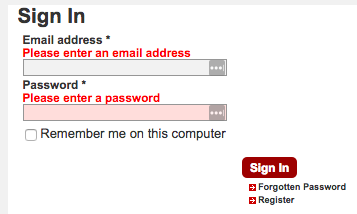
The actual act of saying I'd forgotten my password was a little odd. I did the obvious thing of going to the main website and saying I wanted to sign in.

Sign in on main site

Once clicked, that took me to the actual login page, which has the link to say you've forgotten your password.

Link to reset password

When you click on that link you get taken to.... a login page!

Another login page

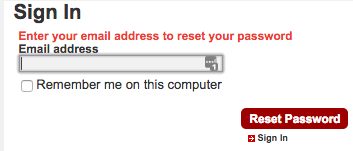
There you then have to say, again, that you've forgotten your password. Only once you've done that do you get somewhere where you can say you've actually forgotten your password.

Finally I can reset

Not horrific, of course, but a rather odd route, needing to click pretty much the same link twice to say the same thing.

Anyway, I tried it, it didn't work, they've had an email to say as much. Now I wait for the next step.

Virgin East Coast 2

3 min read

This morning I called back on the number I'd been given yesterday evening. I explained briefly why I was calling and how I was returning someone's call but, sadly, ended up back in support script-following hell: they started asking for booking reference and all that stuff again. I stopped them, explained the issue again, and they then started to ask for ticket details and so on.

Deeply frustrating. The problem I had was that I was trying to set everything up so I could even stand a chance of booking a ticket. How could I have a ticket I could tell them about if I'd not even got to that part?

When I made this clear, in as polite but firm way as possible, I was passed onto that person's supervisor.

As luck would have it he was the person who'd called and left a message last night. He quickly filled me in on what was happening, saying they weren't sure what the problem was but that the details had been passed to the tech people. He also asked if he could send me an email with some questions in it that would help get to the bottom of things; he said it would ask things like OS type and version, device type, etc. It all seemed to make sense

I said I'd be happy to and we left it at that.

I've had the email. This is what it asked:

1 - Origin and Destination

Gah! Here we go again. The whole support thing appears to be predicated on the idea that you're having a problem getting somewhere. They seem to not understand that if you can't even use the system in the first place you can't even have booked a ticket.

2 - Date and Time

Without a ticket, there can be no date and time.

3 - Number of passengers and railcards if any

Seeing a pattern here?

4 - Ticket name and price

I... erm... hello?

5 - Browser name & version

Finally! We're getting somewhere! Only... my problem isn't in a web browser. My problem is with logging in with their Android app. I'm sure I mentioned this to them at least once.

6 - Screenshot if possible showing the error

Yay! Finally! We're getting somewhere! I pasted in the screenshot that was included in yesterday's blog post. You know the one. The one where it's just some text that says the username and password are invalid. Because... images are better than the text in them, right?

7 - Name of the TOC

I have no clue what this means. TOC? What the heck is a TOC?

8 - Email address of the user

This I can do! I know this one! (I still suspect that this is the cause of the problem).

9 - Booking ref

Gaaarrrrrggghhhhhh!

10 - Screen shot showing exact error and exact steps to recreate the error

Wait... didn't I get asked that in question 6? How is this screenshot going to be different from the other screenshot? Still, at least it asks for the steps to recreate now. So I answered that:

  1. Create a new account on the Virgin East Coast website. Ideally use an email address that contains both a full stop and a plus sign, as mine does. Also ensure that you use a password that is the same length as mine.
  2. Log in and look at registered devices.
  3. See there are none and follow the links it provides to the applicable app that will result in a device being registered. In this case the Ticket Wallet.
  4. Download and install on a suitable Android device.
  5. Attempt to log in and, likely, find that you're told that the username and password is incorrect.


So that's all sent off now. Now I wait for another call back at some point in the near future.

Curious how the thing it didn't ask was what app I was using, what version it was, what mobile device it was being used on, what OS, what OS version, etc...

Virgin East Coast

10 min read

This year has seen me travelling up and down the east coast of England (and into Scotland) quite a bit. Unsurprisingly this means I've been using Virgin East Coast a lot. While I'm no stranger to the rail network (I grew up in York, my father worked for what was once called British Rail, etc) I've not been a regular user since the mid 1990s (when I used to travel from Winchester to London every day).

Much has changed since the last time I used the trains a lot; the big (good) change being that you can do a ton of stuff online and, even more usefully, you can do most things on your mobile phone. Being able to buy tickets from my desk or sofa, and being able to carry all the useful info (times, seat numbers, etc) inside an app makes for an almost stress-free journey.

Up until now I've being using TheTrainLine to do all the booking. The website is uncluttered and easy to use. The same is true of their Android app. I have no complaints at all about how their system works.

But there is one small downside...

The journey I do takes about 4 hours so it makes sense that I settle down and get some work done. Working, of course, requires that I have some sort of Net connection. Ideally I'd just connect via my phone but I find that the signal can't be relied on for large parts of the journey. But that's okay, the trains have WiFi.

It's not cheap though. On Virgin, if you're not travelling first class (something I do do if I can get the right sort of deal) you need to pay £10 to get enough WiFi time to last the trip. Not horrific, but over a few journeys it adds up.

Recently though Virgin East Coast have been doing this thing where, if you book direct via them, you get the WiFi for free. So, while I have no complaints about TheTrainLine, it makes sense for me to book direct with Virgin and hopefully save myself a tenner on the WiFi.

A couple or so weeks back I finally created an account with VEC. I did my usual thing that I do and used a variation on my Gmail email address. You know the sort of thing, make use of the fact that anything after the + in the address doesn't "count" but can be useful to filter things and keep track of who's selling on your contact details.

So I registered as davep.org+virgin@gmail.com. The website accepted it just fine.

The next job was to install their wallet app. According to the website this lets you travel without even needing to faff around with printed tickets: you can do it 100% with your phone (something TTL now do too, I believe). So I downloaded the app, went to log in, and...
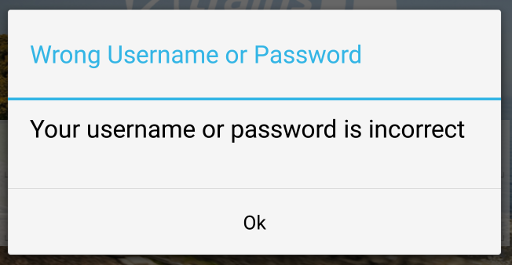
Login denied

I tried a few times, just to be sure that I wasn't being an idiot and messing up but... nope, it just wasn't going to let me log in.

Dammit!

After a few more attempts I gave up and went back to using TTL. Yesterday, however, I decided to look into this again. The problem persisted so I logged into the VEC website, followed the links for getting help with the site (I couldn't see help for the app) and sent a message using the form on the website.

In the initial query I pointed out that I'd like to use the system to book tickets -- especially so I could enjoy free WiFi -- but that the app wouldn't let me log in. I asked how I might fix the problem.

The first reply was:

Could you please confirm which Mobile App you have downloaded and we will advise you accordingly.

Okay, fair enough. I'd spoken about "the app" (although I'd only been offered one via the site) and it seems there's more than one. So I wrote back and confirmed I was talking about the Ticket Wallet.

They replied:

Could you please provide us with your booking reference number and we will advise you accordingly.

I... erm.... Hello? Booking reference? I smell a faint whiff of Catch-22 here.... Never mind. I write back and point out that there is no booking, I'm asking about a problem with their app.

Could you please confirm if you have registered on the Virgin Trains East Coast website and we will advise you accordingly.

Well this is getting fun. I'd been logged in and used their contact form when I sought help. You'd think that it would record this information in some way. Fair enough, perhaps not. So I confirm that, yes, I had created an account with their website and was trying to use that to log in (I also quoted a line from my original message where I'd said this, right from the start).

If you have registered with us please provide us with the email address used as the email address in the original email davep.org+virgin@gmail.com is not recognised on our system.

Erm... Well this is getting silly now. That's absolutely the email address I'd registered with and was logging in with. That's why I was trying to log into the app with it! So I replied confirming that that was the address I'd registered with and hence my confusion.

The reply? This:

I can confirm Virgin Trains East Coast has two Mobile Application, the Virgin Trains East Coast App and the Virgin Trains East Coast Live App.

When you purchase an eligible Virgin Trains East Coast ticket on the website you will be offered the option of having your ticket delivered to your mobile device as an m-ticket.

To use the app, simply sign in with your Virgin Trains East Coast login details, and the app will synch with your online account. If you haven’t registered that device before, it will ask you to name your device. That name will then be shown in your account and when buying tickets, so you can choose which device to send your tickets to.

Thank you for contacting the Virgin Trains East Coast web support team, should you require any further assistance please don’t hesitate to contact us on 03457 225 111.

I... erm.... what? I'm still unsure what this was really telling me. The words made sense, it seemed to be filled with facts, but none of this seemed to pertain to what I was asking them. Worse still, it seemed to give the impression that you needed to have purchased a ticket before you could use the mobile app (at least that's one interpretation I'm getting from the above) and yet, when you follow the links on the website, it says something very different.

I replied pointing out that I was failing to see how that addressed what I'd asked, and I reiterated my problem.

At this point I got a little frustrated and tweeted my frustration:

Which got this reply:

While I get that social media staff, more than any, can be overworked and are often trying to put out all sorts of fires, this wasn't in any way helpful to me. I pointed out what the actual issue was:

I'd also tweeted after my first, talking about the frustration of how TTL seem to do things well, but I only get free WiFi if I book via Virgin:

That tweet got a reply from them asking if I was talking about the wallet app (I was, of course) and if I'd registered with the website first. O_o

So, after a lot of back and forth, I'd got nowhere with this. I did, a little while later, get an email asking for my phone number so they could call me; I replied with it.

The phone call came a little later on. It didn't go well.

At first I was told that the problem was that I needed to purchase a ticket and then that would mean I'd be able to log into the mobile app. Let's just take a moment to really appreciate what's being said: I SHOULD SPEND A HUNDRED POUNDS OR MORE SO I CAN EVEN LOG INTO THE APP.

Only... that's nonsense. According to the website it works very different from that. What the website implies is:

  1. You create an account on the website.
  2. You download the wallet app.
  3. You log into the wallet app with the username and password you use on the website.
  4. This then registers the mobile device with the system.
  5. Then, and only then, can you buy a ticket.

When I pointed this out to the nice lady on the other end of the line she seemed confused by the idea and had to go and check it. She then came back and confirmed that, yes, that's how it works. At which point I asked her how I was supposed to actually log in if it kept telling me my username and password were wrong.

She then suggested that, yes, perhaps there was a problem and could I send a screenshot of the wallet app so they could look into it. A screenshot. O_o

Sure, I guess I could send in a screenshot. You can see it above. It's quite simply the text "Your username or password is incorrect". That's it. That's the problem. It's nice and easy to type. It's text. It's English. I can't see any special pixels that would help debug the issue.

But, nope, it needed a screenshot.

I asked if, perhaps, I could speak with these "technical" people who'd be dealing with this. I was told that that wouldn't be possible and that, instead, she'd have her manager call me. She then hung up pretty sharpish after that.

Right now, as of the time of writing, I'm waiting on that call.

While I do wait, I'm going to make a prediction as to the cause of this. I'm willing to bet the problem is with the choice of email address. So many large companies have systems that assume that + isn't a valid character for an email address. I'm going to further guess that Virgin East Coast isn't one of them when it comes to their website. When it comes to their Wallet App though...


Later in the evening: I never did get a call from the woman's manager, but an hour or so later I did get a call from someone at their "web support team". Sadly I wasn't in a position to take it so I'm no wiser as to what the call was actually going to be about. I'll return the call tomorrow and, all being well, write a second post about what happened.

The main thing I take away from this today though is that, if you (as appears to have happened a few times today) follow a script and don't actually read what the customer is writing, it's going to turn into a very frustrating experience; especially for the customer.

Starting fresh with GNU emacs

3 min read

As I've mentioned elsewhere on this blog, over the past few years, my use of GNU emacs has lapsed somewhat. There was a time when it was my only editor (except for the odd dips into vim to do some quick editing) and, back when I used to use GNU Linux as a desktop machine a lot, I'd have an emacs session up and running pretty much non-stop (it was one of the reasons I wrote uptimes.el).

In more recent times I've been working more on Windows and often inside Visual Studio. Even for my own "for fun" programming, I've mostly being doing things that didn't involve emacs much. In fact, most of my recent "for fun" coding has been done using Sublime Text because it was powerful, cross-platform and also had great support for the language I code in a lot when it comes to personal amusement projects.

During that time I've wanted to get back into emacs. Quite a bit seems to have changed since I was last a very avid user and this also meant wanting and needing to catch up.

The first thing I needed to do was finally get around to killing off my old ~/.emacs file. This has followed me around since I first got into emacs on OS/2 back in the mid 1990s. The file started out with a few setq expressions to tweak some settings and just kept growing and growing. It'd got to a point where there was old stuff in there that I had no use for and sometimes even no idea what it was for. Heck, to give some idea of how old the file was: there were items in there that handled running emacs on MS-DOS!

So, a couple of weeks back, I dumped it. Dumped the whole lot. The plan then was to recreate it with as little hands-on coding as possible. I decided that, as much as I could, I'd tweak using customize and only hand-code (in ~/.emacs.d/init.el this time around) things when there was no obvious other way to do it.

So far this is working out really well. Gone has the ugly and monolithic .emacs, replaced with something far more modular, much more tidy and far easier to maintain. Whereas my old config was almost 1,000 lines long, the new init.el is currently just 50 lines:

;;;;;;;;;;;;;;;;;;;;;;;;;;;;;;;;;;;;;;;;;;;;;;;;;;;;;;;;;;;;;;;;;;;;;
;; Make use of the Common Lisp compatibility module.
(require 'cl)

;;;;;;;;;;;;;;;;;;;;;;;;;;;;;;;;;;;;;;;;;;;;;;;;;;;;;;;;;;;;;;;;;;;;;
;; Local config/lib directory support.

(defun davep:user-path (path)
  "Given `file', return a path for it in the local config."
  (concat user-emacs-directory path))

(defvar davep:local (davep:user-path "davep/")
  "My local config and code directory.")

(defvar davep:startup (davep:user-path "davep/startup")
  "My local startup code.")

(defvar davep:lib (davep:user-path "davep/lib")
  "My local library code.")

(defvar davep:lib-3rd-party (davep:user-path "davep/lib-3rd-party")
  "My local third party code.")

(push davep:local         load-path)
(push davep:startup       load-path)
(push davep:lib           load-path)
(push davep:lib-3rd-party load-path)

(defun have-own-package-p (package)
  "Does a package of my own exist in this environment?"
  (locate-library package nil (list davep:lib)))

;;;;;;;;;;;;;;;;;;;;;;;;;;;;;;;;;;;;;;;;;;;;;;;;;;;;;;;;;;;;;;;;;;;;;
;; Ensure custom values go in their own file.
(setq custom-file (davep:user-path "custom.el"))
(load custom-file)

;;;;;;;;;;;;;;;;;;;;;;;;;;;;;;;;;;;;;;;;;;;;;;;;;;;;;;;;;;;;;;;;;;;;;;
;; Load various startup things.
(load "env-tests")
(require 'davep-keys)
(require 'davep-languages)
(require 'davep-style)
(require 'uptimes)
(require 'csrclr)

;;;;;;;;;;;;;;;;;;;;;;;;;;;;;;;;;;;;;;;;;;;;;;;;;;;;;;;;;;;;;;;;;;;;;
;; Local autoloading.
(require 'autoloading)
(load-davep-autoloads)

All the other stuff, things to tweak language modes so they indent "just so", my own special keyboard bindings, that sort of thing, they're all farmed off into their own files:

davep@Bellerophon:~/.emacs.d/davep/startup$ v
total 40
-rw-r--r--  1 davep  staff  4211 24 May 14:38 davep-keys.el
-rw-r--r--  1 davep  staff  4078 16 May 13:51 davep-languages.el
-rw-r--r--  1 davep  staff   537 25 May 14:13 davep-style.el
-rw-r--r--  1 davep  staff  1339 16 May 09:39 env-tests.el

Another thing I'm trying to do is dump all the old third party code I had locally and, instead, use emacs' own package manager now. Currently this is also working well for me given that I'm using both ELPA and MELPA.

I haven't managed to dump everything yet, but it's a useful exercise to slowly work through the various files I was carting around and deciding if I need them or not (like, I'm fairly sure I won't be needing a cobol-mode any time soon -- that can go).

On top of all of this, on top of starting with a "clean slate" emacs, I've also started keeping track of what I do on GitHub. I've got a private repo for my ~/.emacs.d/ that I can now easily sync between my various machines.

One final thing that I'm starting to try and do is actually make full use of emacs again. One example is that I'm writing this blog post in it. Until now I've been using SublimeText with a Jekyll package to compose and manage things but, this time around I'm giving hyde and markdown-mode a go. So far they're working out pretty well too (albeit hyde was a bit odd to set up and isn't 100% making sense to me yet).

I now own a Macbook

3 min read

I've had my iMac for about 10 months now and I can safely say that it's a purchase I don't regret. While I'm still not convinced by the hype and nonsense that's normally associated with Apple products -- I've had plenty of moments where the damn thing really hasn't "just worked" -- I really do like the iMac as a Unix workstation.

Recently I've had the need to consider buying a small laptop that I can use on train journeys. While I have a very capable Windows laptop it's a little too large to pull out and use on the tray you get on the back of a train seat. I also have a much-loved Chromebook but it would generally fail me on the train unless I always pay for the WiFi. So the ideal machine for me would be fairly small (no more than 12" or so), be capable of doing things locally, and would also need a pretty good battery life (while the trains I travel on do provide sockets they seem to provide no power as often as they do).

I did start to think about going with some sort of Macbook but, every time I looked at them, I ended up deciding they were too expensive.

Until yesterday. Yesterday I found that the local computer store had the 13" Macbook Air on sale -- £150 off the usual price plus another £50 off if I got there and bought it before 5pm.

So I had to go and look.

Having looked I came away with one.

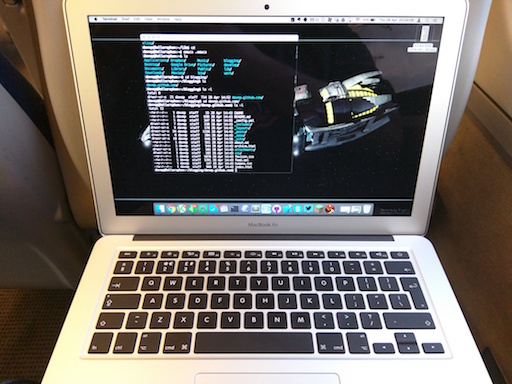
My new Macbook, on the train

So far I'm very pleased with it. While the one I have is the lower spec version (just 128GB of SSD and 4GB of memory) it seems to work well for my needs.

As for what my needs are? I want to be able to work on web projects locally, hack on JavaScript and HTML, that sort of thing. As well as that I want to be able to run Git and, when I do have a net connection, sync to GitHub and browse the web, do email, faff around on reddit, etc.

For this it's perfect. I'm finding it more than fast enough for what I want (I'd even go so far as to say that it's faster than the iMac). The keyboard is just the right size, the trackpad is perfect (and works just like the Magic Trackpad I use on my iMac), the screen is very readable. So far I'm struggling to find any real fault with it.

Okay, sure, there are some obvious downsides, the main one being that, for what I paid for this, I could probably have got a lower-end gaming Windows laptop with plenty of drive space, memory and a good graphics card. But that's not what I was after. A machine that big and that powerful would sit in the laptop bag and not get used. I wanted a machine that was easy to drag out, open up and use.

And that's what's happening with the Air. In fact, it's being used on the train right now; that's where I'm waffling on about this, to kill time, somewhere north of Newcastle, with the sea to my right and the snow coming down.

Until next alarm is back

1 min read

Now and again Google seem to actually listen. While they do generally have a bad habit of removing things from things and saying it's for everyone's good (because options are bad and they can't maintain them, apparently) it seems they can do the odd turnaround now and again.

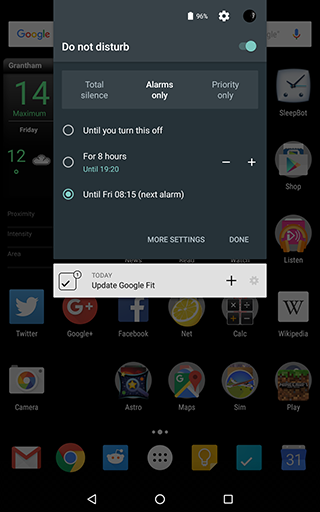
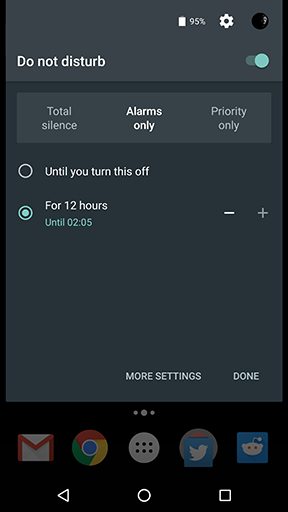
One thing they removed from Android recently was the "until next alarm"" option when putting a device in "do not disturb" mode.

Seems they've added that back in 6.0.1:

Google sees sense

It's a small thing, but it makes so much more sense and makes things so much easier (even if it's a trivial thing).

Nice one Google. More of this please.

My first proper BT broadband outage

5 min read

Until I moved about a year ago I'd always used Demon Internet as my ISP. I stated with them during the old tenner-a-month days when there were only a handful of points-of-presence to be called. I stuck with them through them getting full local POP coverage, through having an ISDN line and then finally ADSL.

When I moved though I decided it might be easier to just go with BT; for the most part this hasn't actually been a bad decision. This week though I suffered my first proper outage with them and it was rather frustrating.

It kicked off at around 2015-11-16 21:00. I noticed that Google Drive (in Chrome) was complaining that it was offline. I then noticed that gmail and a couple of other tabs in Chrome were complaining about the same thing. I did a couple of local network checks and found nothing, checked the router and it was connected and reporting just fine, so then I rebooted the router and things appeared to improve.

For a short while anyway. Then I started to notice other problems; mostly that some sites would time out, others not. Initially I was getting a lot of DNS timeouts and, while I normally use Google's DNS servers (BT's have long had lots of problems1), I tried switching back to BT's own and that appeared to improve matters. For a while anyway.

I mentioned the issues on twitter and got a handful of replies from different people running into similar issues. It was clear that this wasn't just me. I then went looking for BT's broadband status page but hilariously was unable to load it because of the problem.

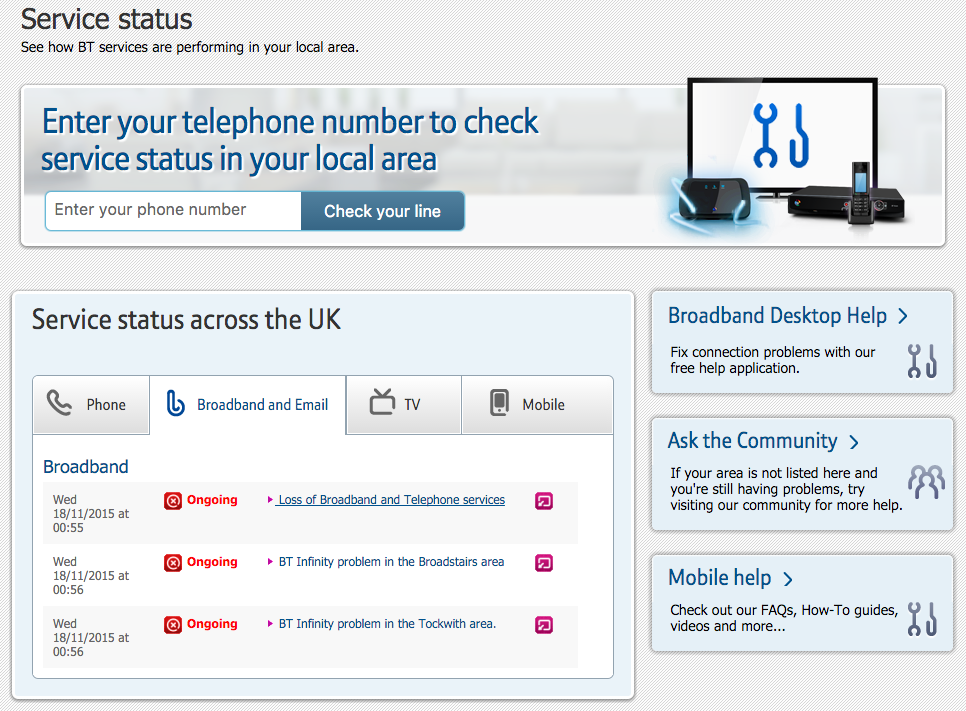
This is my first bit of real frustration with them. Here's how the page looks inside a desktop browser:

Status in desktop browser

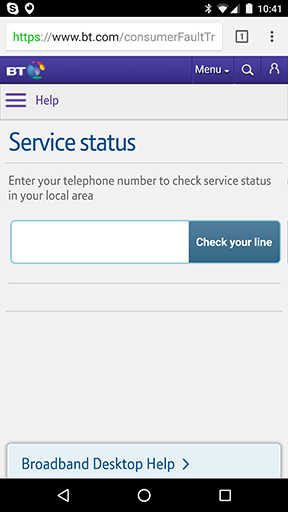
Now compare it as seen inside Android Chrome on my Nexus 6:

Status on my phone

Apparently they have decided that I'd never want to be able to check why my broadband might be down, from a mobile device. Yes, sure, there's the option to put my phone number in -- perhaps it tells me after I've done that -- but I don't even know my land line number; I don't use it as a phone most of the time and so never bother remembering it. The main point here is why the hell wouldn't they include the same useful information as the desktop view? Or perhaps use geolocation of the phone to narrow things down if they feel the need.

Anyway, I gave up and went to bed. In the morning things were no better but, after another router reboot, I did manage to get a view of the status:

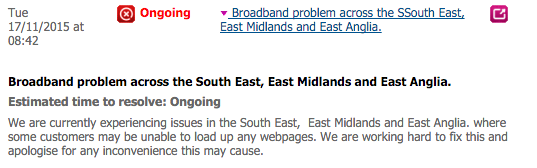
Finally got to see broadband status

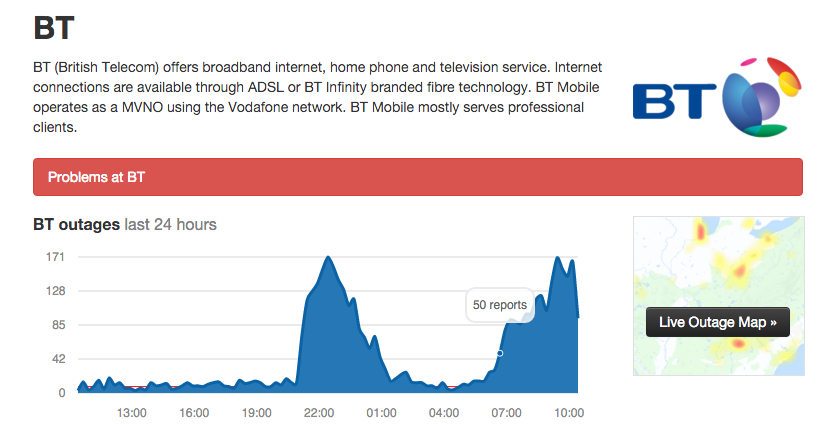
Finally! Acknowledgement of the problem. Worryingly though it was dated almost 12 hours after I first noticed the problem. From what I can see that date and time isn't the date and time the status was last updated, it's the date and time it was first added. That suggest that they really hadn't noticed the problem all night. It's not like it was a problem that was hard to notice, at least from a customer's point of view. Check this graph from a down detector site:

It really was down

You'd think that a company as big as BT would have something in place that could catch network problems, especially ones that are able to be caught with a simple crowdsourcing "press this button if you have a problem" approach.

But... nope. Appears not. O_o

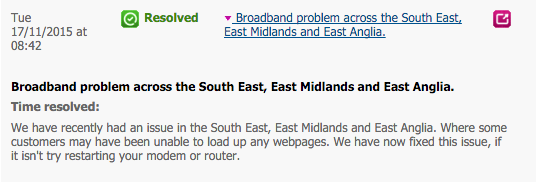
Anyway, a couple or so hours later the problem was finally fixed:

Finally got to see broadband status

(Notice how the date and time is the same as earlier; so 100% not an update time but a first-added time) I mentioned this on twitter:

and I even got a reply (which I'd not gone looking for, so that was nice):

Curious as to why it'd take almost 12 hours from the problem appearing to it being acknowledged on their status, I thought I'd ask:

which got this reply:

which doesn't really make a whole lot of sense. Sure, you to spend time identifying the source of a problem to fix it, but you don't need to do that to notice and acknowledge that there's a problem. I've asked again but haven't received any sort of reply as of the time of writing (I'm not expecting one really).

What I take from all of this is that BT are shockingly bad at keeping people informed of problems with their service when there's a large outage. I find that kind of annoying. I don't mind that there are problems, I do mind when a company can't take the time to clearly and quickly state "yup, it's us, it's not you, we're looking into it..."


  1. Don't even get me started on how the HH5 won't allow setting of DNS servers in the hub itself. That's stupid and frustrating beyond words. 

A little bit of usenet

2 min read

Earlier on today I needed a copy of wget on my iMac. It's not "native" to it so I got to wondering how you go about getting something like that onto it. Sure, I could have just grabbed the source and built myself, but really it's a lot nicer to use some sort of package manager.

A quick search lead me to Homebrew and I was then up and running in no time.

This in turn got me to thinking about how it might be fun to get some of the software I used to use on my GNU/Linux machine up and running again. The first one that came to mind was slrn. Sure enough slrn is available via Homebrew and installing it was dead simple.

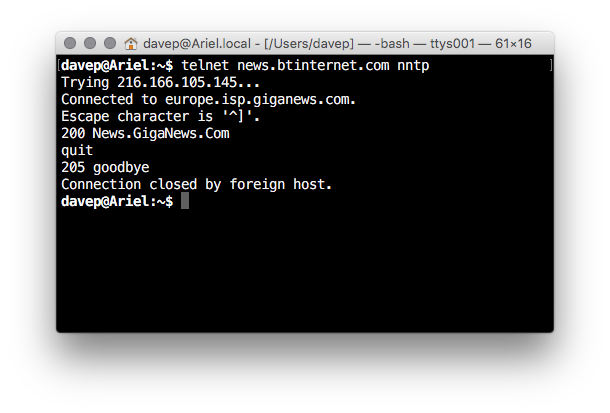
But then I was faced with a problem: I needed an NNTP server. Way back I used to run a local one in my office that fed from and to my ISP's. Back then my ISP was Demon Internet; these days I'm with BT. A quick search lead me to an article or two that BT had a NNTP server, of sorts, provided by a third party. So I did a quick check:

Is the server there?

Yay! This looked good.

After that I fired up slrn and.... problems. It kept asking me to log in, to provide a user name and password. The only problem was that I'd read in more than one place that a user name and password weren't needed for BT's server; all that was required was you be on a BT IP address. Checking the slrn docs I found force_authentication but ensuring that was off made no difference.

At this point I removed slrn and gave up.

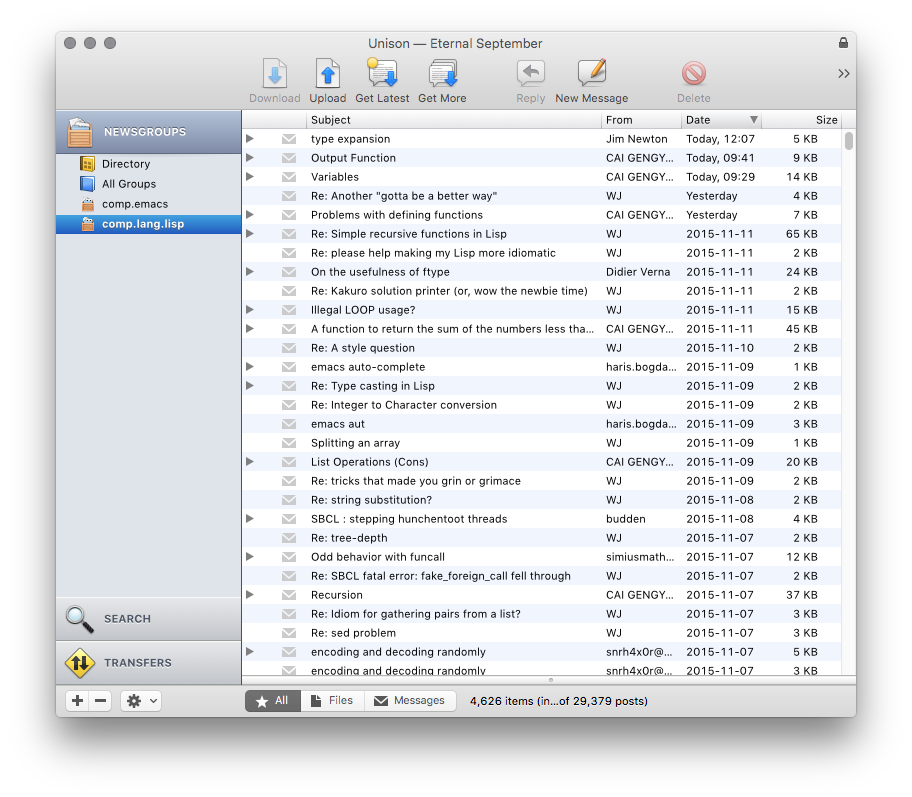
Later, thinking it might be an issue with just slrn and perhaps it was worth trying a native NNTP client, I grabbed Unison (which is no longer supported but seems to work fine). I got that set up and ran into the same issue: it wanted login details.

Finally, after a bit more digging, I stumbled on the reason why I was struggling to make any of this work: BT had closed support for the server back in December last year!

A quick search around the web and I stumbled on Eternal September. Given all I was interested in was the good old text groups this looked perfect. I quickly registered an account, ran up Unison again and plugged in my details and....

Is the server there?

Now that's all sorted I should try again with slrn. At which point I'll need to drag out and tidy up post.el (the version that was being maintained by some other people seems to have gone very stale, sadly).

I miss "Until next alarm"

2 min read

I actually can't remember when the change was now, it was either Android 5.0 or one of the 5.x point releases, but I can recall the frustration of Google having changed how you make an Android device silent, or not. The idea seemed clever enough but it was a real pain to switch to and use. Previously there'd simply been this neat system of setting he volume to either be some non-off value, vibrate or totally silent. I even had a neat little widget on the home screen of my phone to allow me to toggle between these 3 states.

It was simple, and worked well.

The new system though.... ugh. It was confusing and so much more long-winded to work with.

At some point though they added one big redeeming feature: "Until next alarm". When I got into bed I could tell my tablet to go totally silent until my alarm went off in the morning, and then it would all work as normal. That was an utterly brilliant idea.

So it made sense that if they changed anything about this in Marshmallow they'd keep that in and make it even more awesome, right? Right?!?

Nope

Well fuck!

Why? Just..... why?!? I actually prefer how the new one works. They've more or less solved the problem of how it was more faff to deal with, they've solved the problem of having to cock about with the volume rocker to get at the settings and then set the settings. I like all that.

But taking "Until next alarm" away? That's just nuts.

Sometimes I really get the impression that the Android developers are like the Chrome OS developers: they're having a ton of fun improving and onward developing the system but they have little connection to how people actually use this stuff.

Voice search failing on Nexus 6

1 min read

It's been quite a while since I used voiced search on my Nexus 6. Ever since I got the Moto 360 I've not really had a need to say "OK Google" to my phone because I could simply say it to my wrist. Today though, because I wanted to quickly look something up and my phone was to hand, I spoke to it and got this:

Voice search fail

Brilliant.

I've been here before. I had exactly this sort of problem with my Xperia Z at one point. The problem appeared to go away eventually (actually, it sort of came and went a few times over a matter of weeks, if I recall correctly), although I never really got to the bottom of the cause.

I've tried rebooting the phone and that hasn't helped at all. While it's more of a vague annoyance than anything else (like I say above, my Android Wear device is my goto tool for talking to Google these days) it does frustrate a little when fairly expensive tools don't "just work".